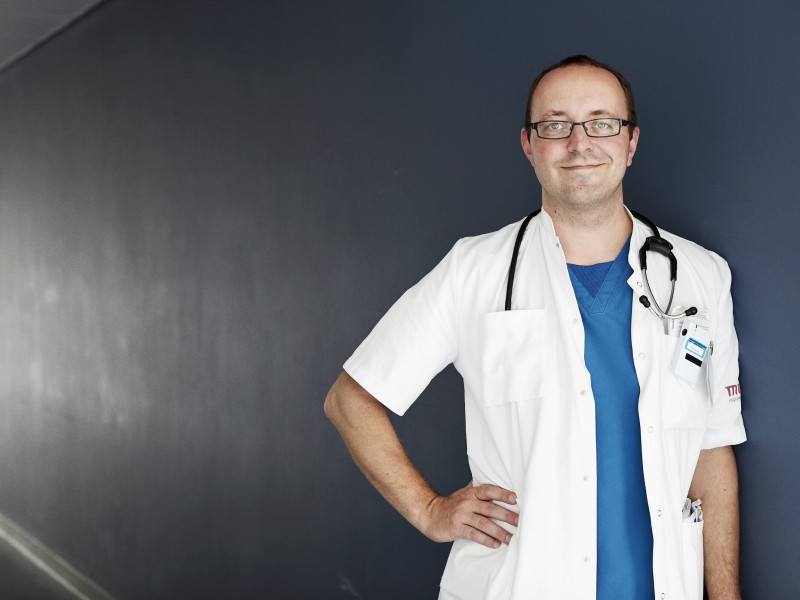
‘A brilliant example of an early proof of mechanism’ — Dr Joachim Tillner, Sanofi
Dr Joachim Tillner, Clinical Research Director at Sanofi in Germany discusses two studies he did with CHDR's Immunology Group.
Can you tell me about your collaboration with CHDR
‘The first study I was involved in was a first-in-human trial with an IL-2 agonist in healthy participants. We chose to work with CHDR because they could include their KLH challenge in the multiple ascending dose study. I think this is an important expertise of CHDR, that they have these human challenge models to deliver proof of mechanism at an early stage of clinical drug development. The study was concluded some time ago. It did provide us with useful information and the compound is now being studied in patients.’
‘In the second study we did together, the first-in-human studies had already been done elsewhere, but we wanted more information on the compound’s pharmacodynamics. At Sanofi, whenever possible, we aim to have proof of mechanism before we move into studies with patients. This compound is an antagonist to three different cytokines, making it quite complicated to study. CHDR tested it with their imiquimod and LPS challenge models using two other drugs as comparison and I must say I was really impressed by the results. Everything came out exactly as we had predicted beforehand. Internally, in our company, it’s still being shared as a brilliant example of an early proof of mechanism’.
What’s so important about these challenge models?
‘It’s not always easy to study an antagonist in healthy participants, because there is no pathological activity to inhibit. So, there might be some slight changes in biomarkers, but overall, it’s difficult to prove target engagement. This compound aims to inhibit three cytokines. So even if it had proved to be effective in patients, it would still be uncertain if it successfully inhibited all three. This study showed it even better than I had expected beforehand. If there are so many readouts, it is reasonable to expect that some outcomes will not confirm your hypotheses, but in this case, the outcomes ticked all the boxes and our decision matrix.’
‘The compound in the first study was an agonist, so it is easier to show target engagement, using biomarkers such as shifts in cell populations. But still, the challenge model added information about the specific changes in T cell activation that make this a promising immunomodulatory drug. So, I really believe in the value of these challenge models and I really hope CHDR will go on developing new challenge models to target other mechanisms.’
How was your collaboration with CHDR?
‘I really enjoy working with every member of their team. They are different from other CRO’s who do early clinical development - they are more science-driven and less profit-oriented. I appreciate their honest approach. For example, I discussed the possibility of recruiting a specific group of dermatology patients, and they told me it would be quite a challenge to find enough patients. Another CRO might have said that it’s easy to recruit those patients and then fail to deliver.’
‘They are also different because they have their own opinion and their own standards, which may take some getting used to. Most CRO’s will essentially just do as I tell them, but with CHDR we’ve had some serious discussions about important decisions, especially in the first study. I’m glad we reached a satisfactory conclusion, and I’m looking forward to working with them again. In fact, we are already discussing our next study together.’
Interested in learning more?
More articles from Developing drugs